
Motion Control of Mechanical Systems with Backlash
Abstract
Backlash is a mechanical interaction which occurs with clearance between structural parts of a mechanical system. The clearance causes noncompletion, nonuniform rotation or displacement of structure parts. Due to the clearance errors in positioning and motion of structure parts occur. In this paper, a software based solution for mechanical systems with backlash is presented. To achieve accurate speed control, a Proportional-Derivative (PD) compensator is combined with a Proportional-Integral (PI) controller. The correct controller is adopted by a Genetic Algorithm (GA). As the criteria for the system, first, overshoot, second, error performance index are considered. According to ITAE criterion, there exists very low oscillations in the step response of the system. This indicates good system stability.
Keywords:BacklashCompensatorGenetic algorithmITAE criterion
1. Introduction
Backlash is a nonlinear system disturbance, which is an undesirable system performance. It is basically the play between neighboring moving components. This phenomenon in mechanical systems, especially at the beginning of motion, is inevitable [1]. This phenomenon is found in gear trains, bearings, and other similar mechanical connections.
In gear, the minimum distance between the non-driven teeth is known as backlash [2]. A certain amount of backlash is required for the correct gear transmission. When the backlash is less than the proper amount, the gears will interfere, and when the backlash is too much, it will cause the system to be slack [3]. Compressed gear meshing or precision gears can be used to eliminate backlash [4]. However, there are some disadvantages for compressed meshing. It may increase friction and gear interference.
In addition, the method of using precision gears is very expensive and is generally undesirable in practice. The above drawbacks emphasize the importance of system control. With proper controller design, the detrimental effects of backlash can be eliminated non-mechanically [5].
Nordin et al. [6] studied compressed backlash, which is a type of backlash that is valid only for shafts with damping. In this case, backlash is assumed for system elements, motor, load, and shaft. The proposed model is very accurate. Thomson et al. [7] designed three methods for speed control of two-mass systems, which are a PI controller, a 4th-order state-space controller, and a 5th-order state-space controller. In state-space control, if all of the states cannot be measured in the system, then system control is difficult.
Shahgholian et al. [8] used a linear controller to compensate for backlash in a position control system. The system's step response indicates a small amount of overshoot. Extensive research has been conducted on backlash modeling, identification, and compensation in mechanical systems.
Woodside et al. [9] developed a feedforward kinematic error controller incorporating an angular positioning deviations model for backlash compensation in industrial robots, demonstrating a 25% improvement in circularity accuracy.
Iklodi et al. [10] investigated stick-slip oscillations in grinding machine feed motions caused by the interaction of dry friction and backlash, providing valuable insights into low-speed motion stability. Wang et al. [11] proposed an oscillation suppression method for automatic loading manipulator arms using a Third-Order Nonlinear Extended State Observer (TNESO), achieving a reduction in positioning error from 0.006 rad to 0.001 rad through backlash disturbance compensation.
Larkin et al. [12] presented a novel approach combining neural network tuning with Genetic Algorithms (GAs) for controlling hierarchical systems with backlash, demonstrating that evolutionary changes during system operation can significantly improve control characteristics. A recent study on backlash size identification proposed a Hilbert-Huang Transform-based method to determine the exact timing of gear disengagement, enabling maintenance scheduling and improved compensation [13]. Research on tracking mechatronic systems with variable backlash size has shown that systems with switchable feedback on motor and load shaft positions exhibit lower sensitivity to varying backlash magnitudes [14]. Additionally, novel compensation methods for teleoperation systems have been developed using two identical counter-operating drives per joint to cancel backlash effects in both geared systems and thrust-wire mechanisms [15].
2. Speed Control
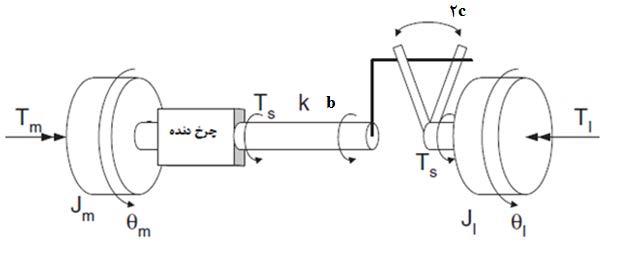
Typically, in motion control, the system consists of a motor, a load, and a gear transmission [1]. In any mechanical system where the motor (driving member) is not directly connected to the load (moving member), backlash exists [6]. A real mechanical system is a complex multi-mass system in which masses are connected by flexible shafts. Nevertheless, a multi-mass system can be approximated by a two-mass model [2], where the first mass is assumed to be the motor, and the second mass is the load and shaft with free inertia. In this section, the two-mass system shown in Fig. 1 is used.
In this paper, a controller based on a GA is provided for speed regulation of systems with backlash. Overshoot and the ITAE index are used as system evaluation criteria. To achieve this goal, a Matlab®/Simulink™ model is presented [16]. The objective function is minimized using Matlab® optimization functions. The goal is to achieve a stable system despite the presence of backlash.
This figure is shown in the PDF version of the article.
Under the following assumptions, the speed control of the two-mass system is analyzed:
The gear ratio is 1. Friction is neglected.
The control input is the motor torque, Tm, and the output variable is the load speed, ω. Eqs. (1) and (2) show the motor transfer function, Gm, and the load transfer function, Gl, respectively. Jm, Jl, bm, and bl are the motor moment of inertia, load moment of inertia, motor damping, and load damping, respectively.
Gm = (1)
Jms + bm
Gl = (2)
Jls + bl The motor and load are coupled by an elastic shaft. The shaft is modeled by a spring with stiffness coefficient kk and damping coefficient b [7]. The internal damping of the shaft is very low. Eq. (3) shows the shaft transfer function:
bs + k
Gs = (3)
In this analysis, the gear is located close to the motor. The gear ratio is assumed to be 1, the backlash is of the compressed type, and the backlash size is assumed to be 1 degree. The driving part generates torque, which is transmitted to the load via the elastic shaft [2]. The actuator dynamics are assumed to have a time delay Td and a time constant Tc. The actuator transfer function, G, is considered according to Eq. (4): Table 1 presents the system specifications.
e−Tds
G = (3)
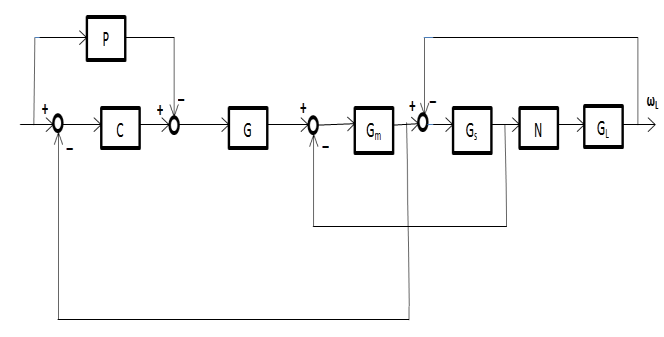
1 + Tcs The block diagram of the system under study is considered according to Fig. 2. In Fig. 2, C is the controller, P is the compensator, and N is the backlash. The transfer functions of the controller and compensator are defined based on Eqs. (5) and (6).
Table 1. System parameters.
This table is shown in the PDF version of the article.
This figure is shown in the PDF version of the article.
3. Optimization
In this research, the goal is to achieve a stable system despite the presence of backlash. The system performance evaluation criteria are the maximum overshoot and the error performance index. For system stability, the design process begins by determining the desired performance specifications. These specifications are:
I. The maximum overshoot should be less than 20% .
II. The error performance indices should be minimized.
In the analyses, the ITAE index is used. ITAE is the integral of time multiplied by the absolute value of the error. The controller is designed during the optimization process to satisfy the desired conditions. The method used for optimization is the GA. Typically, for speed control of two-mass systems, controllers with a Proportional-Integral (PI) structure are used [7]. In this paper, a combination of a PI controller with a Proportional-Derivative (PD) compensator is proposed for system control. As observed in Fig. 3, feedback from the motor side is assumed because, from an industrial perspective, measuring load speed is expensive and nearly impossible [6]. Optimization is performed on the controller gains.
Using the GA, the objective function is minimized. The decision variables are kp , ki, kp1 and kd1 which are, respectively, the proportional gain of the controller, the integral gain of the controller, the proportional gain of the compensator, and the derivative gain of the compensator.
This figure is shown in the PDF version of the article.
The specifications of the applied GA are according to Table 2.
Table 2. GA specifications.
This table is shown in the PDF version of the article.
The design results can be seen in Tables 3 and 4. These results were obtained through simulation and programming for controller optimization using the GA in Matlab® software.
Table 3. Optimal gain values for the two-mass system and the ITAE objective function value based on the GA.
This table is shown in the PDF version of the article.
The step response of the system based on the data in Table 3 is shown in Fig. 4.
This figure is shown in the PDF version of the article.
According to Fig. 4, the system is stable. The maximum overshoot of the system is 8.5%, and its rise time is less than 1 second (approximately 0.72 seconds).
4. Results and Discussion
Backlash exists in any mechanical system where the driving member is not directly connected to the load. In gears, when contact between the teeth is lost, the load becomes disconnected from the motor, and the driving torque only moves the components before the backlash. Backlash can lead to significant difficulty in motion control and instability.
In this paper, speed control of a system with backlash was investigated. For system control, the simultaneous use of a PI controller and a PD compensator was proposed. Based on the ITAE criterion, the maximum overshoot of the system was 8.5%, and its rise time was less than 1 second (approximately 0.72 seconds). The step response of the system exhibits negligible oscillation, which indicates system stability. Simulations show that the proposed method for designing the optimal controller is efficient.
Conflict of Interest
The authors declare no conflict of interest.
Data Availability
All data are included in the text.
Funding
This research received no specific grant from funding agencies in the public, commercial, or not-for-profit sectors.
Figures
References
- [1] Liu, J., Yao, J., & Deng, W. (2024). Nonlinear robust adaptive control of electro-hydrostatic actuators with continuous friction compensation. International journal of control, automation and systems, 22(4), 1225–1237. https://doi.org/10.1007/s12555-022-1120-6
- [2] Hovland, G., Hanssen, S., Gallestey, E., Moberg, S., Brogardh, T., Gunnarsson, S., & Isaksson, M. (2002). Nonlinear identification of backlash in robot transmissions. In Proceedings of the 33rd ISR (international symposium on robotics) (pp. 1-6). https://home.uia.no/geirh/PDF/C20.pdf
- [3] Kalantari, R., Sadat, F. M. (2009). Backlash nonlinearity modeling and adaptive controller design for an electromechanical power transmission system. Transaction b: Mechanical engineering, 16(6), 463–469. (In Persian). https://www.sid.ir/en/VEWSSID/J_pdf/9552009B607.pdf
- [4] Jiayi, H. U. (2006). Control of mechanical systems with backlash problem [Thesis]. https://scholarbank.nus.edu.sg/handle/10635/15083
- [5] Bruns, R. M. R., Diepstraten, J., Schuurbiers, X. G. P., & Wouters, J. A. G. (2006). Motion control of systems with backlash. In Technische universiteit eindhoven. (pp. 1–42). Technische Universiteit Eindhoven. https://pure.tue.nl/ws/portalfiles/portal/4295876/633392.pdf
- [6] Nordin, M., & Gutman, P. O. (2002). Controlling mechanical systems with backlash—a survey. Automatica, 38(10), 1633–1649. https://doi.org/10.1016/S0005-1098(02)00047-X
- [7] Thomsen, S., & Fuchs, F. W. (2009). Speed control of torsional drive systems with backlash. 2009 13th European conference on power electronics and applications (pp. 1–10). IEEE. https://ieeexplore.ieee.org/abstract/document/5278771
- [8] Shahgholian, G., Faiz, J., & Shafaghi, P. (2009). Analysis and simulation of speed control for two-mass resonant system. 2009 second international conference on computer and electrical engineering (Vol. 2, pp. 666– 670). IEEE.
- [9] Woodside, M. R., Cui, T., Emelko, J., Ibaraki, S., Landers, R. G., & Bristow, D. A. (2024). A feedforward kinematic error controller with an angular positioning deviations model for backlash compensation of industrial robots. Manufacturing letters, 41, 1579–1584. https://doi.org/10.1016/j.mfglet.2024.09.184
- [10] Iklodi, Z., Piiroinen, P. T., Franco, O., Beudaert, X., & Dombovari, Z. (2025). Stick–slip oscillations in the low feed linear motion of a grinding machine due to dry friction and backlash. International journal of non-linear mechanics, 168, 104940. https://doi.org/10.1016/j.ijnonlinmec.2024.104940
- [11] Wang, J., Zou, Q., Xu, Y., Chang, S., & Li, Y. (2024). Backlash compensation based oscillation suppression control for automatic loading manipulator arm with nonlinear extended state observer. Nonlinear dynamics, 112(16), 14253–14280. https://doi.org/10.1007/s11071-024-09836-w
- [12] Larkin, E. V., Bogomolov, A. V., & Privalov, A. N. (2025). Neural network tuning of the genetic algorithm for controlling a vector hierarchical system. Informatics and automation, 24(5), 1333–1354. https://doi.org/10.15622/ia.24.5.3
- [13] Wu, B. F., & Cheng, M. Y. (2024). Backlash size identification for servomechanisms with gear transmission devices. Precision engineering, 91, 132–142. https://doi.org/10.1016/j.precisioneng.2024.09.011
- [14] Apolonskiy, V. V, & Tararykin, S. V. (2025). Methods of controlling tracking mechatronic systems with varying backlash size in highly rigid kinematic transmissions. 2025 international conference on industrial engineering, applications and manufacturing (ICIEAM) (pp. 615–620). IEEE.
- [15] Prasanga, D. K., Sariyildiz, E., & Ohnishi, K. (2015). Compensation of backlash for geared drive systems and thrust wires used in teleoperation. IEEJ journal of industry applications, 4(5), 514–525. https://doi.org/10.1541/ieejjia.4.514
- [16] Yang, W. Y. (2018). MATLAB/Simulink for digital communication. A-Jin Publishing Co., Korea. https://media1.ppf.edu.rs/2020/12/MATLAB_Simulink_for_Digital_Communicatio.pdf